Some cookies used are essential to providing a service, while others help us improve your experience and provide us with insights into how the site is being used.
For more detailed information about the cookies we use, see our Cookies page.
Necessary cookies enable core functionality such as security, network management, and accessibility. You may disable these by changing your browser settings, but this may affect how the website functions.
We'd like to set Google Analytics cookies to help us to improve our website by collecting and reporting information on how you use it. The cookies collect information in a way that does not directly identify anyone. For more information on how these cookies work, please see our 'Cookies page'.
We'd like to allow Social Media cookies to provide a richer experience. These cookies will allow us the ability to list Fife Council tweets and Facebook posts, Google maps, audio clips & Videos on some of our pages. Our videos use Youtube's privacy-enhanced mode.
These cookies allow us to show relevant adverts to the content you are viewing. They also provide the ability to deliver targeted online advertising across other platforms like Facebook, Google, Instagram and the Quantcast network.
Get Mapping: A Picture Can be Worth a Thousand Words
A genogram is a visual picture of who is in a family and the nature of relationships. Although ‘doing’ a genogram is helpful, its greatest value comes from exploring what it is telling you about a family, taking an analytical approach and using this to inform your future work. Patterns in a family history can suddenly jump out in a visual map and help consider the emotions and circumstances underpinning the patterns. They also help identify important and trusted people in a child or adult’s life that can support safety or alternatively highlight worries for safety.
Whilst there is some variation in the symbols and structures used to complete a genogram, there is general acceptance on the universal symbols. The main universal symbols used are shown here and a template can be downloaded here.
These universal symbols are used to describe individuals and their relationship to each other.
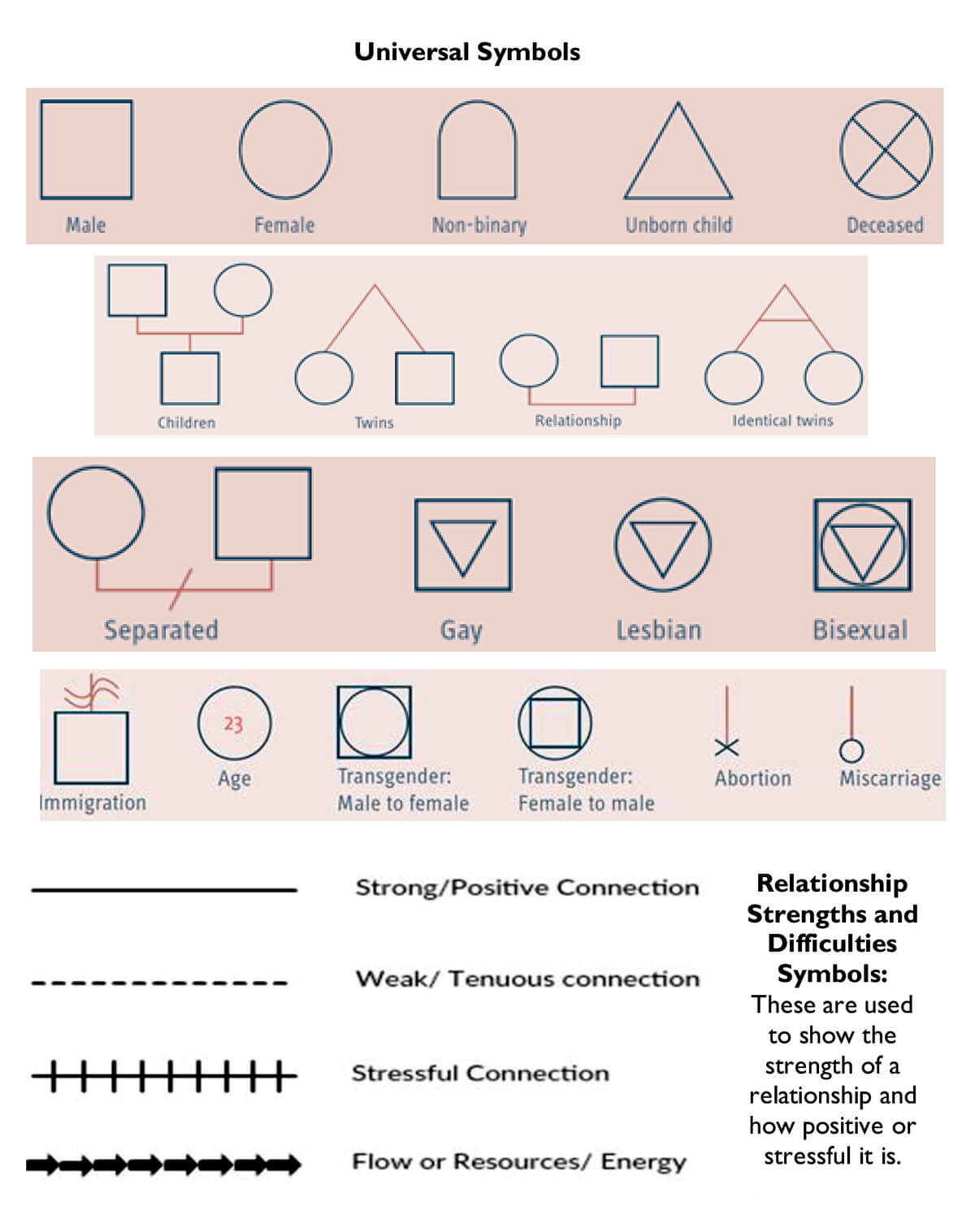
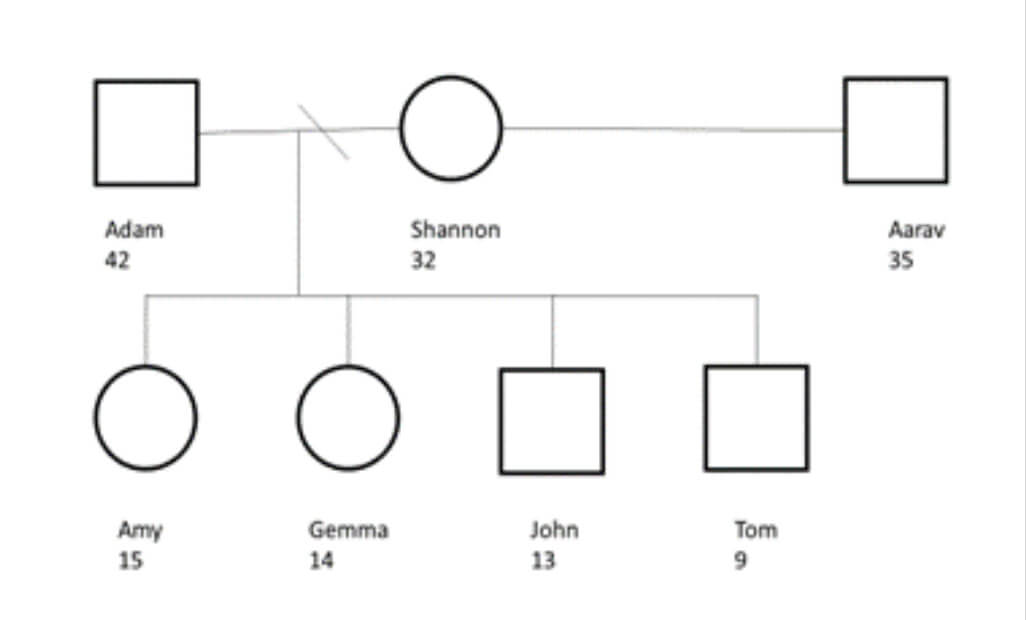
Genograms can be used at any point in your work. Initially you might want to sketch out a genogram based on your knowledge or information received about a family. This can help you to quickly gain an understanding of who is in a family and even through a basic genogram highlight areas for further exploration through being professionally curious.
What questions does this basic genogram raise for you?
Creating a genogram can be a powerful thing to do and, for adults in a family, can bring up painful memories of previous or current trauma. For this reason, it is important that when doing a genogram with a family to explain what it is and how it can raise sensitive issues. Having a trusted professional relationship with the adults can help ensure a safe space for discussion. Use your professional judgement in deciding when to do a genogram with a family and who should be involved.
Being mindful of the emotions involved in doing a genogram is perhaps even more important when completing one with a child. Think about the appropriateness and timing. There’s no right way of constructing a genogram with a child child, but preparation and creativity is crucial. Explain in language they can understand what a genogram is and importantly why it is helpful. Sharing with a child that you would love to hear about who is in their life so you can best help them demonstrates a genuine care and interest in their world.
Families tell us how difficult it is to have to repeat their story and experience to agency after agency. Think about what this means for you in suggesting doing a genogram. Have they done it already with any other agency or worker and what was their experience? Has anything changed since then? How can you add to existing work or add value by doing it a different way?
We’ve mentioned how emotional doing a genogram can be, but it is important to recognise that it can also be a positive experience for families and children. Crucially, it can make sure that family strengths and networks can be identified and brought into support plans.
Ideally, genograms should cover at least three generations. However, if you do not have this information, that is useful for analysis. Does it mean a lack of family support? Is the family isolated? Is there trauma in previous generations that parents don’t want to revisit or known?
Your organisation may have expectations about when and how to complete a genogram so please check with your agency requirements and practice standards.
Use your supervision or workplace support systems to make genograms purposeful for a family. If you are a supervisor or manage others, ask to explore a family genogram to inform practice going forward.
We hope you have found this a useful starting point to understanding and doing genograms. Below are links to further resources to develop your learning: