Some cookies used are essential to providing a service, while others help us improve your experience and provide us with insights into how the site is being used.
For more detailed information about the cookies we use, see our Cookies page.
Necessary cookies enable core functionality such as security, network management, and accessibility. You may disable these by changing your browser settings, but this may affect how the website functions.
We'd like to set Google Analytics cookies to help us to improve our website by collecting and reporting information on how you use it. The cookies collect information in a way that does not directly identify anyone. For more information on how these cookies work, please see our 'Cookies page'.
We'd like to allow Social Media cookies to provide a richer experience. These cookies will allow us the ability to list Fife Council tweets and Facebook posts, Google maps, audio clips & Videos on some of our pages. Our videos use Youtube's privacy-enhanced mode.
These cookies allow us to show relevant adverts to the content you are viewing. They also provide the ability to deliver targeted online advertising across other platforms like Facebook, Google, Instagram and the Quantcast network.
The ‘My World Triangle’ is an ecological framework for holistic assessment of a child or young person’s needs. It considers how they grow and develop in relation to the care they receive and their wider social and physical environment.
The model analyses the interaction between three domains to identify unmet needs, strengths, risks, and protective factors. It supports a thorough understanding of factors affecting development and guides actions that can help.
This is not a checklist but a dynamic approach that applies to all children and young people, including those not yet born. It takes account of achievements and family strengths, as well as potential or actual risks of harm.
The framework emphasizes listening to children and young people, considering their views, and working in partnership with parents and carers. It provides a clear, staged process—from identifying needs through analysis, planning, and review—ensuring the child’s and family’s perspectives inform every step.
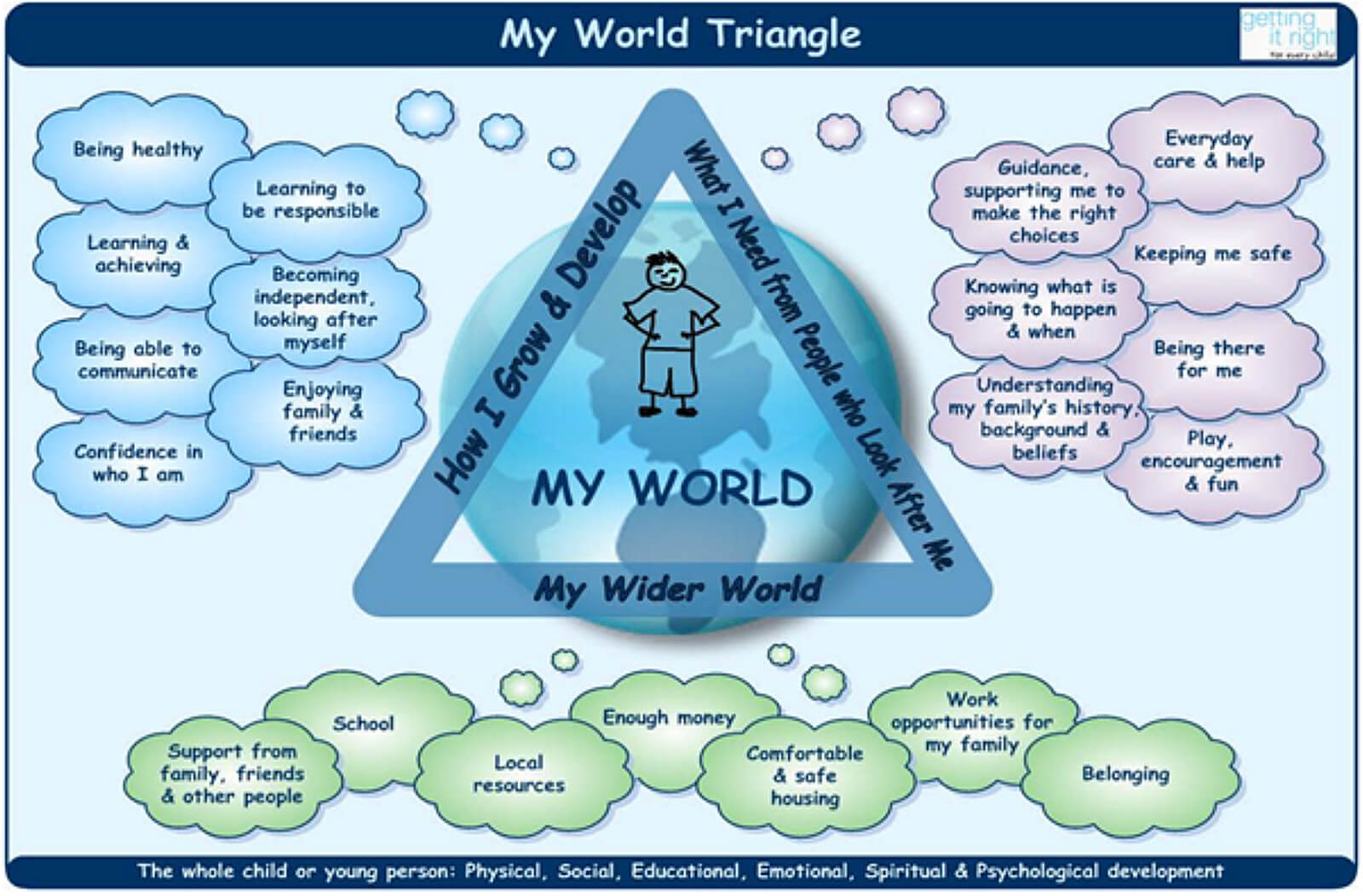
How I grow and develop is where consideration should be given to factors in the child or young person's life relating to various aspects of physical, cognitive, social and psychological development. In order to understand and reach sound judgements about how well a child or young person is growing and developing, practitioners must think about many different aspects of their lives, including learning and achieving, positive relationships with family and friends, self-confidence, independence and communication.
What I need from the people who look after me accounts for the critical influences of other people in the child or young person's life. Parents normally have the most significant role, but the role of siblings, wider family, teachers, friends and community is also important. Considering the inputs from people surrounding the child or young person can indicate where other supports are required. Practitioners must think about a range of factors, including everyday care and support, positive adult role models, knowing what is going to happen and when, and an understanding of family background, beliefs and culture.
My wider world reflects how the communities where children and young people grow up can have a significant impact on their wellbeing and the wellbeing of their families. The level of support available from a child or young person's wider family, social networks and within their neighbourhood can have differing effects. Practitioners must think about the local context including employment, education, healthcare, housing and a sense of belonging and safety.